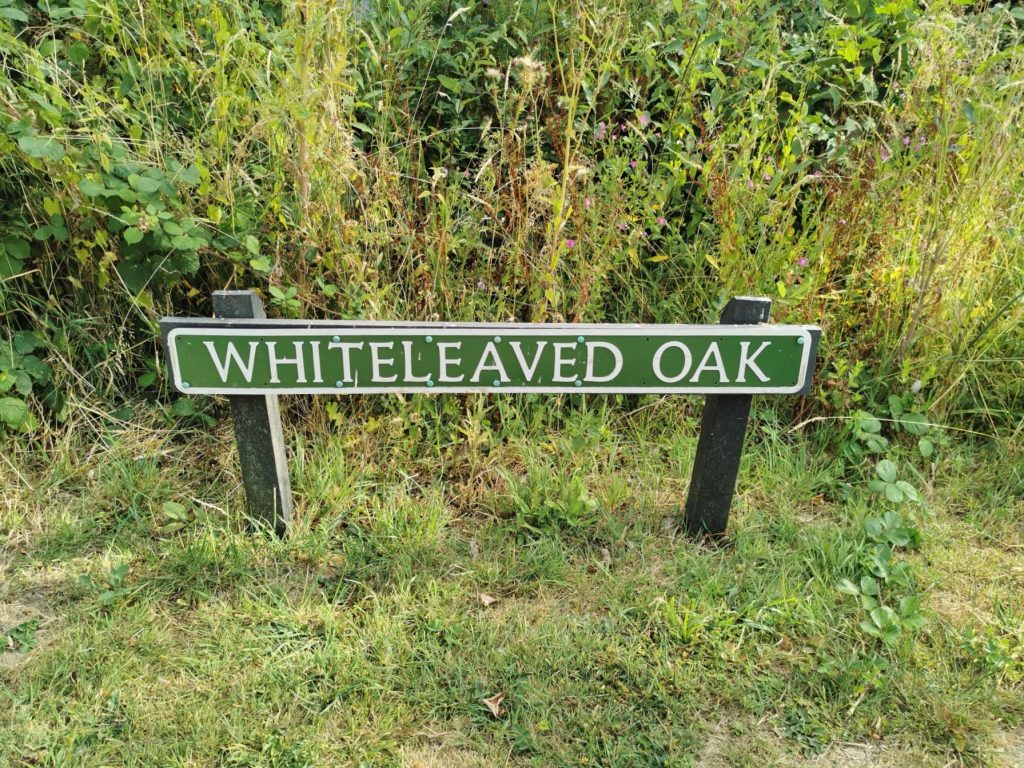
I have to tell you something about trees that’s not just about trees. But I’ll let the trees tell the story, the way they told me.
The story begins with a journey to a tree that no longer exists.
I’d stumbled across the tale of the white-leaved oak in an old book. An ancient tree, long since lost, its variegated leaves preserved only in the village named for it, and known as an historic meeting place at the junction of three counties.
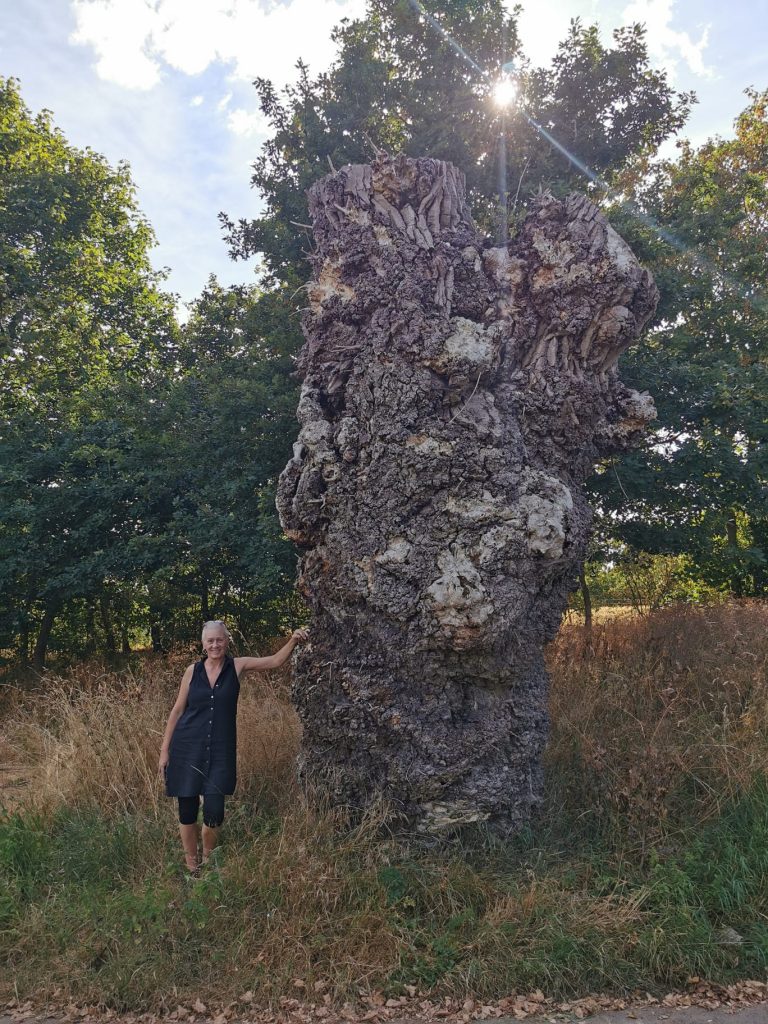
The story of this lost tree had become attached to another ancient oak nearby. This second tree, more recently lost, burnt to the ground a few years ago.
I went looking then, not for what had been lost, but for what remained.
A search stretching into many weeks revealed a story both complex and confused.
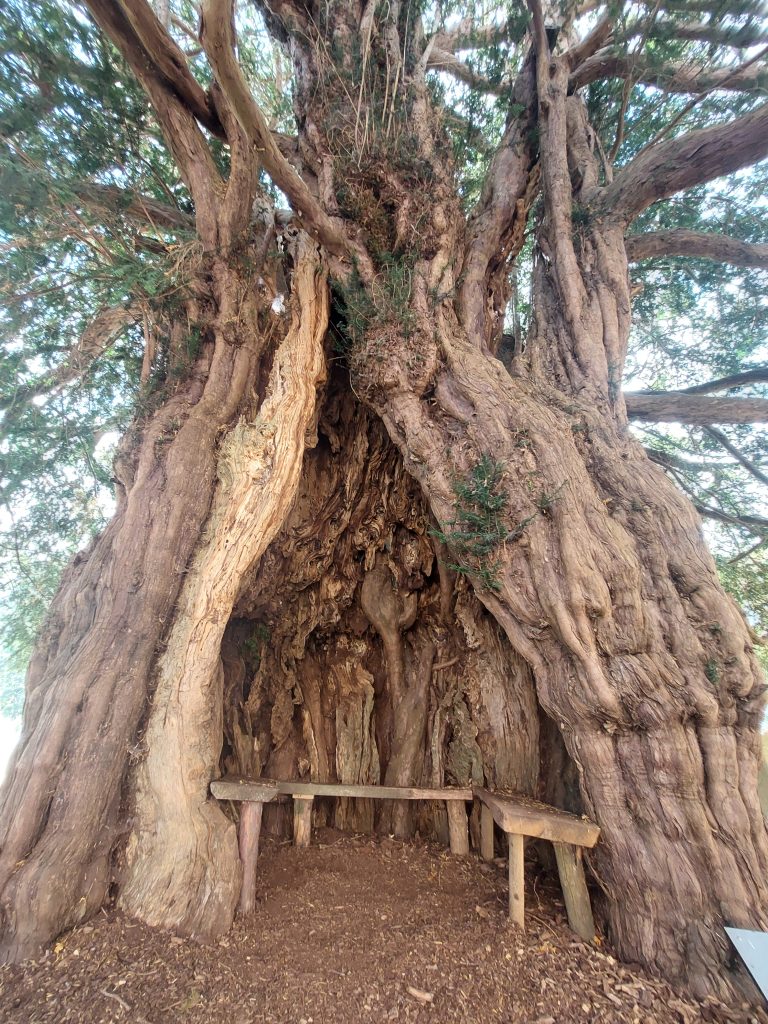
But the journey we undertook that first day, my friend and I, was no less convoluted. For en route, we conspired to visit the Much Marcle Yew, rooted, like so many of our ancient yews, on ground believed sacred long before the churchyard enclosed it. Her heavy boughs propped up, her majestic trunk hollow and flared at the base, the very image of an old grandmother holding open her skirts for her children to shelter, inviting you to stand within or sit upon the benches lining three sides of her trunk.
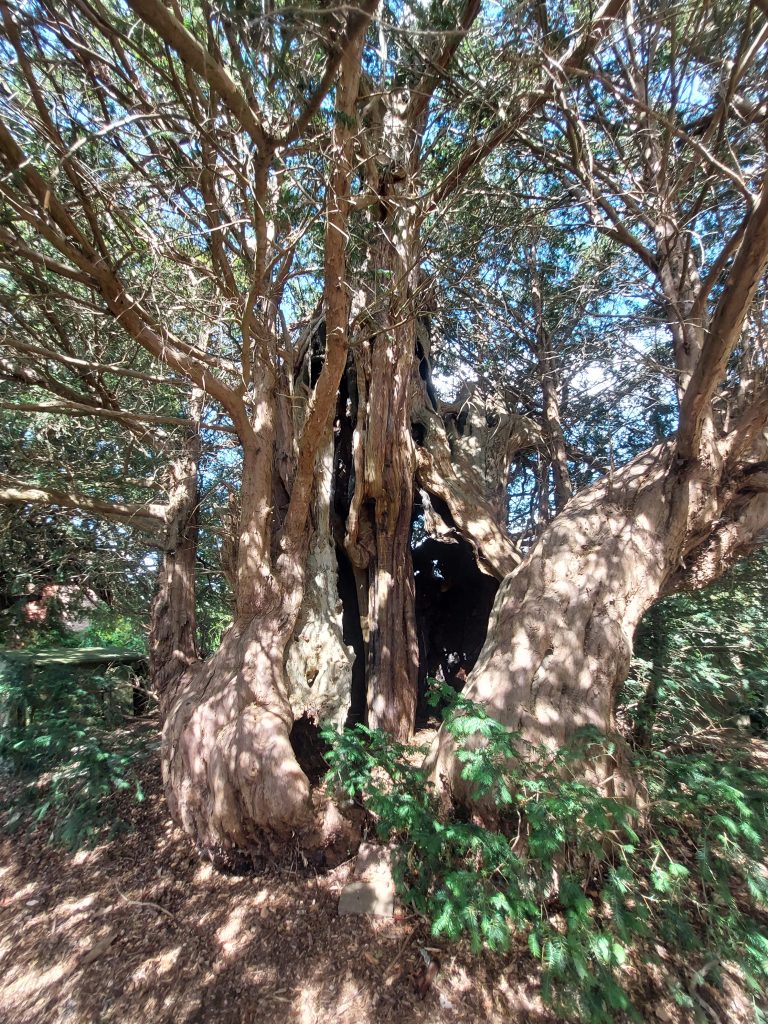
An encounter in the neighbouring church led us to the nearby Linton Yew. Quite different to Much Marcle’s, this yew felt gently introspective. Bright new growth tipped its branches, and a young trunk rose through the fire-damaged hollow of its ancient core. Gathered thus around its own regeneration, the very embodiment of the death and rebirth folklore of the yew, I could only respect its reserve and admire its staunch resilience.
And there were other trees on this journey: an old sycamore, growing in the hedgerow where we’d pulled over to read the map, only a hundred or so years old, yet remarkably beautiful in its own anonymous way; the remains of an
ancient crossroads tree, with all the gravitas of a prehistoric megalith, its rotting trunk home to new life of fungi, holly sapling, and wild rose.
And then we came to the village of Whiteleaved Oak. We could only wonder about where the original tree may have stood, and a misleading grid reference for the second tree took us to an empty corner of an undulating field. Since we knew not what we were looking for – were the remains still visible? had anything been placed to mark the spot? – we left unsure and empty-handed. But a seed had been planted, and I determined to figure out the conundrum.
Over the coming weeks, I found myself untangling a conflation that ran through almost every account: the village named Whiteleaved Oak; the original tree, already ancient four centuries ago and lost to us for well over a century; and this other non-variegated tree, so often referred to as ‘the white-leaved oak’.
My book-based travels took me right through that valley on the heels of a Victorian botanist as he recorded the notable old trees of the Malvern Chase. I read modern accounts of the ley lines of an ancient circle of perpetual choirs, said to centre on this place. And online, I studied old maps of county boundaries, and facebook posts about the second tree and its fiery destruction.
And still I felt none-the-wiser as to where either tree had actually stood.
For all my research, it was, of course, a chance encounter that led me to the site of the second tree: discussing my search with a local historian, she spotted the “Pagen Oak” boldly marked on google maps nearby*. Assuming it was another notable tree, I sought clarity only to find … more confusion. Until finally it clicked: this was the spot I had been looking for.
By then I had grown cynical: the Pagen Oak seemed no true successor, but an imposter luring the gullible.The local farmer’s wife confirmed my hunch that this tree had drawn attention only in recent decades. Yet the place I eventually encountered completely disarmed me. The blackened roots of the old tree were still visible on the rim of a strange bowl in the landscape; two younger oaks stood further around this rim; the meadow stretched away to another veteran tree; and hills ringed the horizon.
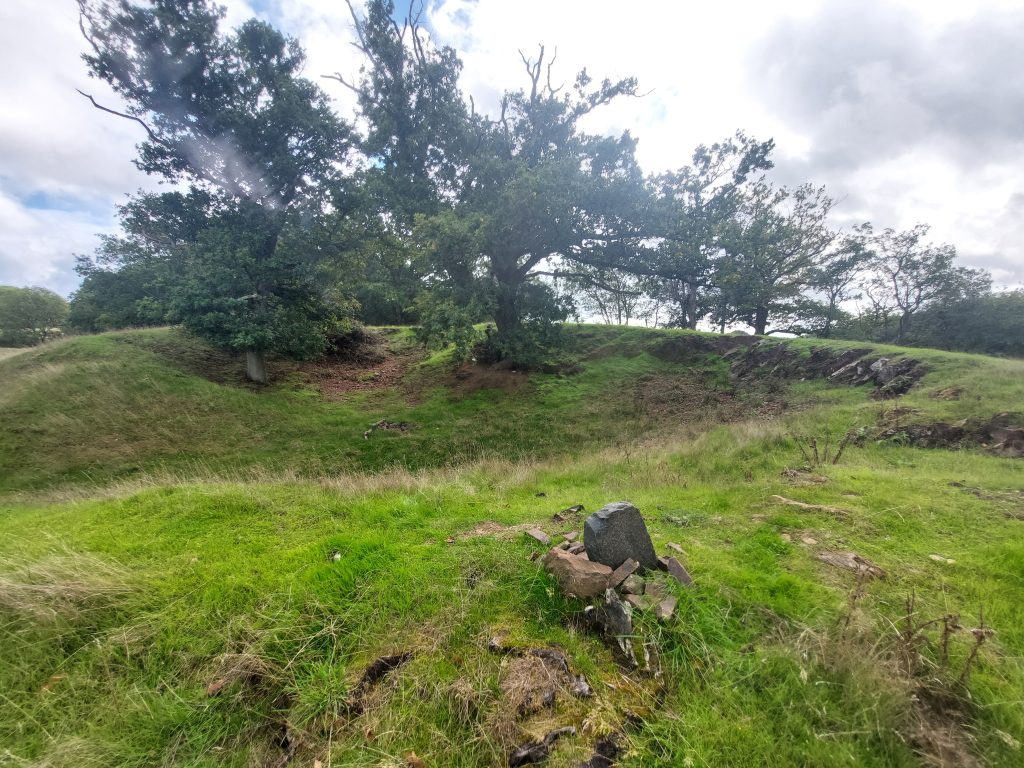
Who can know whether the energy of this place drew the people to it, or whether the echo of their presence, their repeated acts of veneration, imbued the land with its special quality?
But what I felt in my body as I tarried there, I can only describe as enchantment.
Yet that was not the only magic this meandering journey through trees had bestowed upon me. For something happened after that first expedition, something to do with attention – or, perhaps more precisely, with proper acquaintance.
The huge oaks outside my gate no longer blended into the surrounding greenery, but stood forward, stately and proud. And cycling along this familiar lane, great specimens of ash, of oak, of hawthorn presented themselves. A little further afield, a great phalanx of pollarded sycamores lured my attention. I could barely move around my locality without being interrupted by another beauty. Not all ancient, but each one individual and arresting.
And I remembered a year or so ago, walking with another friend and her dog in a scrappy bit of woodland outside the town. We stopped in our tracks, fascinated by an incredible willow, its enormous trunk cracked and fallen, its upright branches become trees in their own right. As we clambered in and out of its myriad forms, in awe and celebration, my friend turned to me and said “Does everyone see this, or do they just see ‘tree’?”
I had always noticed extraordinary trees, but they were mainly just that: an extraordinary tree.
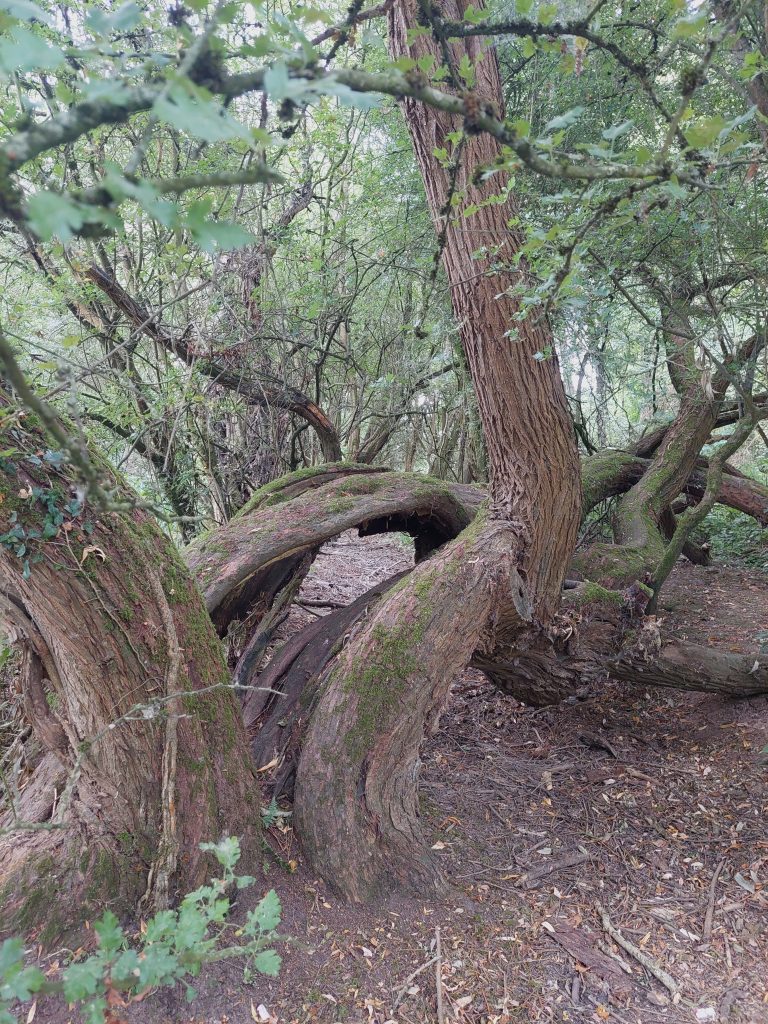
But gradually, in my journeys through landscape and text, I had acquired a new vocabulary of seeing. Now I saw oak or ash, willow, yew, alder. I saw girth and age. I saw pollarding. I saw decay and new life.
And it wasn’t just trees: churches became Norman arches, medieval paintings, Saxon fonts; landscapes revealed hillforts, burial mounds, holloways; place names gave clues; history unfolded in layers all around me.
And as I sit here writing this, a tiny bird lands momentarily on the windowsill. Autumnal sun streams through the windows of this treehouse, perched high above a Cornish valley. I think of the river below, visited only yesterday, and wonder about the red mineral crust on its wetted rocks.
So much of this I do not know, cannot yet name. But the noticing is where acquaintance begins.

*Footnote: It is my belief that the “Pagen Oak” marked on Google maps is a user-contribution and a misspelling of Pagan Oak. However, I have decided to use the Google maps spelling


Leave a Reply