Category: Place & Belonging

  • Seeking the Stones

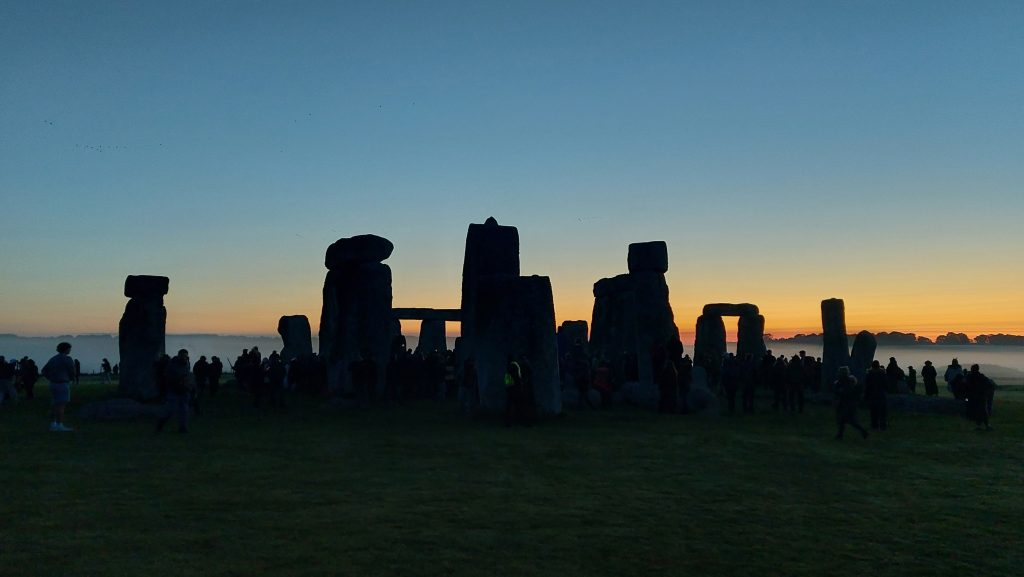
    Silhouetted by the pre-dawn sky, people gather amonst the monoliths of Stonehenge, September 2023

    Those magical monoliths, known as Stonehenge, have been like a compass in my life, drawing me back to true north whenever I’ve lost my bearings.

    I guess that explains the visceral anger I felt upon passing the stones late last year and seeing the drove blocked off to public access. I mean, I already knew it was closed, ostensibly for repairs, but actually driving past and being unable to pull over and spend a moment reconnecting, brought up a whole history of emotional and political engagement. All alone in my car, I cried out, “No! You can’t do that. They’re OUR stones.” I had literally fought for access to this place, and the drove was the last remaining spot where you could pull up for free and spend a little time in their presence.

    It was others who eventually got the powers-that-be to the table to negotiate open access for solstice and equinox celebrations. My part was one of persistent resistance, and that mattered too: the handful of us that turned up year after year and peacefully made our stand, meant that its significance could not be forgotten or ignored.

    I wasn’t involved in the ‘roundtable’ talks because these took place during a period in which I had, quite dramatically, lost my bearings. But when I did eventually return, one summer solstice, I was overjoyed to find myself among thousands of people from all walks of life gathered to welcome the sunrise.

    My only abiding memory of that encounter was looking around and seeing not just the usual crowd of hippies, punks, and druids, but also people whose paths I would never have expected to cross there, in that field of mud and rocks. Families with sleepy toddlers, elderly folk in sensible shoes, tourists with cameras slung around necks, nine-to-fivers in office attire, and youngsters in puffer jackets and white trainers.

    What I felt in my belly was a flicker of pride at recognising that I, in a minuscule way, had played a part in keeping the stones alive and open for all to enjoy.

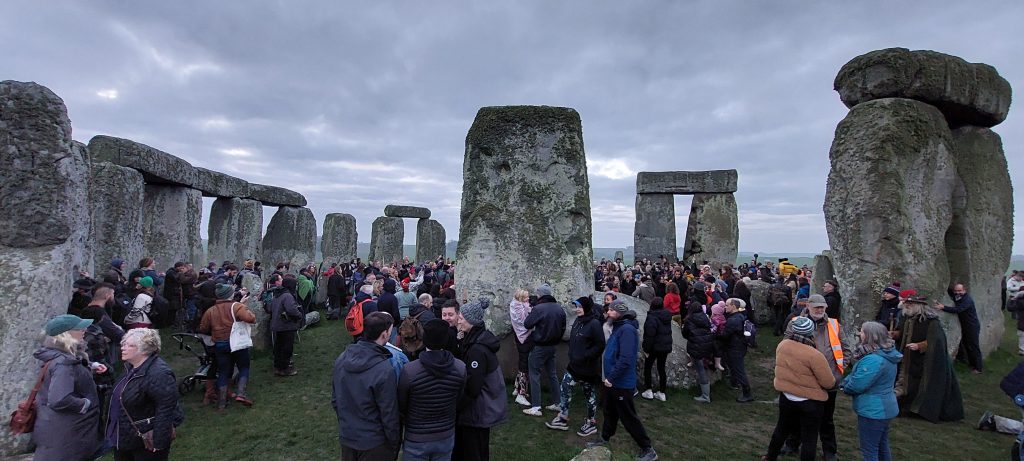
    A crowd of people gathered amonst the monoliths at Stonehenge. The sky is overcast and grey. March 2024

    In truth, I tend to avoid the summer solstice these days due to the sheer numbers and the level of management imposed to cope with them. I get it, but it just isn’t my flavour.

    The equinoxes are my favourite haunt, when a smaller, more familial atmosphere presides. Vehicles of all descriptions stretch off into the distance along the aforementioned drove. Music hums, people hop between the staggered campfires, new friendships are made, and old ones are rekindled.

    You still see a fair cross-section of people on the drove. Tourists wander through, van-lifers are prolific, and young families turn up in their shiny cars.

    All are made welcome.

    One autumn equinox, we got chatting to a young American dude from a coach tour who was so enthralled by the atmosphere that he remained with us for several days before catching up with his tour bus.

    I love chatting to all and sundry, especially here. I was shocked, at first, to learn that so many had no inkling of the bloody history that was lodged like a thorn in my heart.

    You see, I may have said earlier that we turned up peacefully year after year, but that’s not the whole story. I wasn’t at the Battle of the Beanfield, but I was close enough to it, to the people who were there, to absorb some of the trauma and injustice of this unprecedented state brutality.

    Two years later, when I had left school and left home, I dived headlong into the fray. In a hand-painted matte black car with luminous yellow lightning up the sides, my friends and I were going to try and make it to the stones for solstice. Instead, we spent the day being run around in circles by heavy police roadblocks marking the exclusion zone. It was crazy to see such a militarised response to the simple desire to gather near the stones and celebrate the sunrise.

    After many hours of frustration, we eventually pulled in along the bumpy track to Cholderton Woods, several miles away. Resigned to a quiet weekend amongst the handful of others already tucked away there, we began to set up camp. But as dusk fell, a trickle of vehicles arriving turned into a continuous stream. The woods came alive with music, laughter, and campfires.

    On the night of the solstice, after several visits from police armed with threats and intimidation, it was somehow agreed that we would simply walk to the stones for dawn.

    I will never forget that surreal, subdued march, like refugees in our own country. Helicopters chattered overhead with loudspeakers and spotlights. Police in unmarked boiler suits loitered in the shadows, throwing out taunts and threats. Spread across the whole dual carriageway, we trudged on through the pre-dawn light.

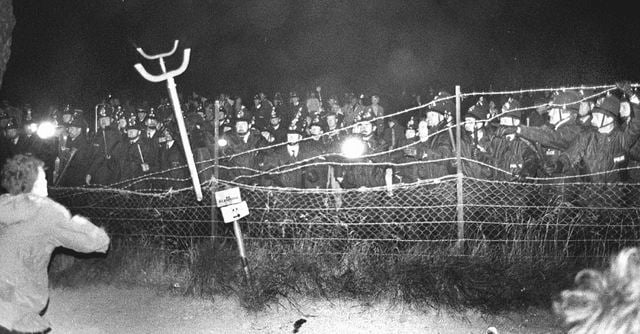
    As Stonehenge finally came into sight, lit by glaring floodlights, we were met with ranks of riot police behind metal security fences circling our beloved stones. I won’t lie, it got ugly at times. There were skirmishes as people tried to pull the fences down, shouting angry abuse at the coppers. Fear at what they were capable of, hidden beneath bravado.

    But of course, the violent force of the law won out, and shortly after dawn, we scattered across fields as the police charged.

    Ranks of riot police stand behind a barbed wire fence around Stonehenge, late 1980s
    Photo courtesy of Alan Lodge https://alanlodge.co.uk/OnTheRoad

    What followed from this was years of cat-and-mouse. The police presence gradually stepped down as those of us still trying to reach the stones diminished. It almost became a game. One year, my friends and I walked from Amesbury and traversed the last few fields on our bellies, commando style. We actually got within about 30 feet of the stones before we were spotted by the widely-spaced police cordon. We couldn’t stop laughing at the ridiculousness of it, and I think even the coppers thought so by this time, simply escorting us out of the field.

    Another year, pregnant with my first child, the power to police the stones had been handed over to a security firm in fluorescent jackets. There was no real aggro, but at some point numbers must have tipped in our favour and the security guards simply withdrew. Triumphantly, we surged over the chest-high fences and hugged those stones.

    The relative ease and tranquillity of access in recent years – temporary drove closure aside – is like a balm on the wound. Little wonder that I made it my first car camping destination following another hiatus of lost bearings.

    It wasn’t just my bearings that I found here either. It still is the place where I meet my brother with every turning of the seasons. And when he was still alive, my dad could usually be found here as well.

    I’ve shared this place with other ‘family’ too: city friends, lovers, and once even my boss and her son. What drew them, I think, was seeing how deeply I was drawn back to this place and wanting to experience it for themselves.

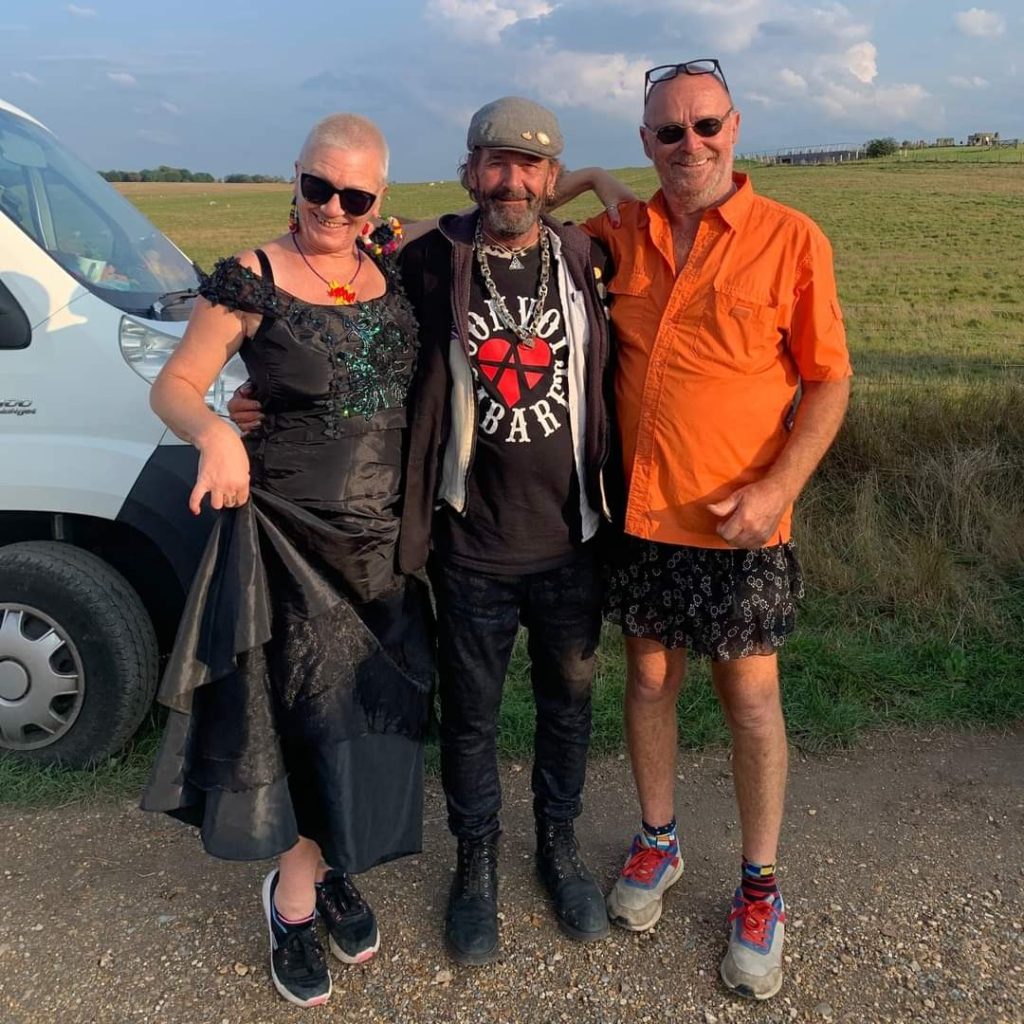
    The author, her brother, and a friend meet up on the drove, September 2023

    If you are interested in learning more about the Battle of the Beanfield, there are some excellent links on YouTube, for example:

    (Please be aware, there are some distressing images/scenes)

    Ambush on the Beanfield Part 1 (3.19)

    Ambush on the Beanfield Part 2 (5.48)

    Operation Solstice (58.31)

  • In Search of Springs

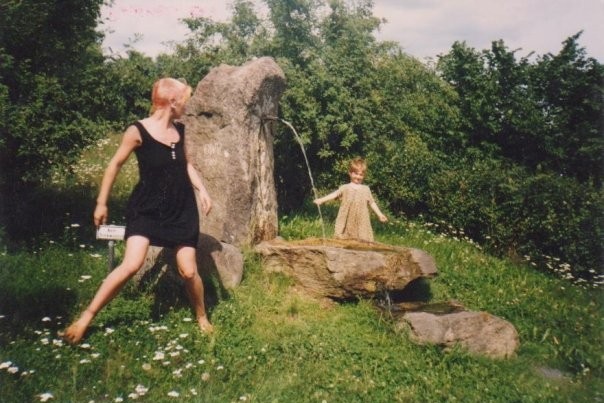
    A young woman (the author) is caught mid-turn, looking back at her 5 year old daughter who stands with arms outstretched beside a rocky spring. They are surrounded by grass, wildflowers and trees

    My fascination with springs and holy wells may be fairly recent, but my relationship with water sources is much older.

    One of my earliest memories, in fact, from about four years old: me and my brother amusing ourselves by racing raindrops down the clear polythene of our parents’ makeshift camp in the middle of a thunderstorm.

    Once housed, we had to share bath water twice a week, but we also swam in rivers, splashed in puddles, and took trips to the beaches of Wales and North Cornwall. I can still remember the gritty sandwiches and the taste of salt on my lips, shivering with a towel around my shoulders on the beach.

    As I came into adulthood, living on the road as a ‘new age’ traveller, sourcing water became part of the weekly routine. I loved the fact that basic necessities such as this required some effort, but it was still a chore at times. If I was travelling with others, there would usually be a joint ‘water run’, where we would all load our empty containers – an assortment of plastic butts and metal milk churns – into one vehicle and go fill up from a tap at the nearest service station or churchyard.

    Sometimes we were refused water. This was the 1990s and the media’s frenzy about the “threat” of travellers was occasionally reflected back to us from ordinary people. On the whole, though, my experience of Joe Public ranged from tolerance through to vicarious longing.

    But as the 90s and its privatisation policies wore on, water became more tightly controlled and access became increasingly difficult. Gradually, the very stuff of life became enclosed. Another locked gate, another padlocked tap.

    One of the few photographs I have on my wall is of me and my daughter at a spring in 1996. The spring is almost incidental – what I love is the slightly ethereal quality of the photo. But it reminds me that even then, we would seek out springs to fill our water butts where possible. I don’t remember it becoming a necessity, though; we usually found somewhere willing to let us use their tap.

    In the early 2000s, I moved into bricks and mortar for a number of years. Metered water was just a fact of life – I didn’t give it too much thought.

    So my fascination with springs in recent years has been part of a wider grounding in my life – a return to the source, if you like.

    It really got started when I was seeing a guy who lived down in Cornwall and piped his water from a spring on his own land. But Cornwall is littered with springs and holy wells, and we began to explore them in earnest.

    One of the springs we visited was Dupath Chapel Well, a place I’d encountered many years previously on a strange and magical solo mission.

    On that earlier occasion, when I lived nearby, I had actually set out to find an earthworks, spotted on the OS map. My curiosity led me across a couple of fields when I spotted the farmer trudging up towards me. My first instinct was to turn and walk the other way, afraid that he would lecture me for being on his land.

    Something in me rejected that response, and so I walked down towards him.

    In fact, he seemed quite delighted when I told him I was looking for the earthworks. He not only told me where to find them, but also shared the nearby location of a large badger sett and gave me his blessing to visit at twilight to quietly observe them.

    Heart warmed by his openness, and having walked the undulating earthworks, I headed back to the car.

    It was then that I realised I was parked almost opposite the turning for Dupath Well Chapel – a sign I had passed literally hundreds of times. Of course, this was the day to find out what this even was.

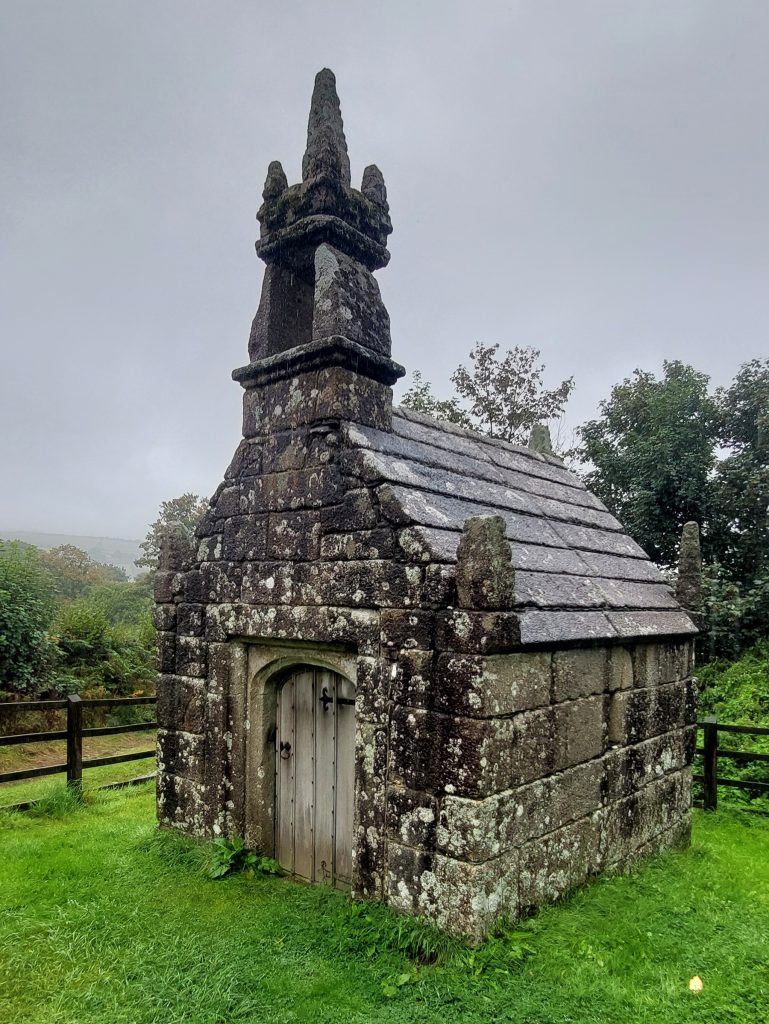
    Initially, I found myself directed into a working farmyard. My uncertainty faded though, when I saw a signposted footpath leading to an incongruous, granite construction. Stocky and rectangular, it had a steep stone-tiled roof and a kind of sentinel-like spire rising above the open doorway.

    The lichen-covered stone was evidently several hundred years old and the place had presence.

    But it was when I stepped inside, sunlight streaming through the empty windows, that I was truly enchanted. The spring on which this chapel was built fed into a shallow stone trough across the back of the stone-paved floor. And that was it, just water in a trough in a stone room. But it was so much more: I felt like I’d entered some magical realm as I just stood, motionless, and absorbed the atmosphere.

    Taken on a rainy day, this view of Dupath Well Chapel shows the front of the granite building with it's 'sentinal-like spire' and one side of the roof and wall. It is set on closely cropped grass, with a wooden fence and trees in the backgroud.

    Springs and holy wells nearly always have this kind of effect on me, and I wonder if the very earth, stone, and trees that surround them – not to mention the water itself – have somehow absorbed the veneration of all those who have visited over the centuries.

    Dupath’s construction was not especially unique among the holy wells we visited that summer, many years later. Some were even more ornate and others were of a much simpler design, but each one built of the inscrutable granite hewn from the local landscape.

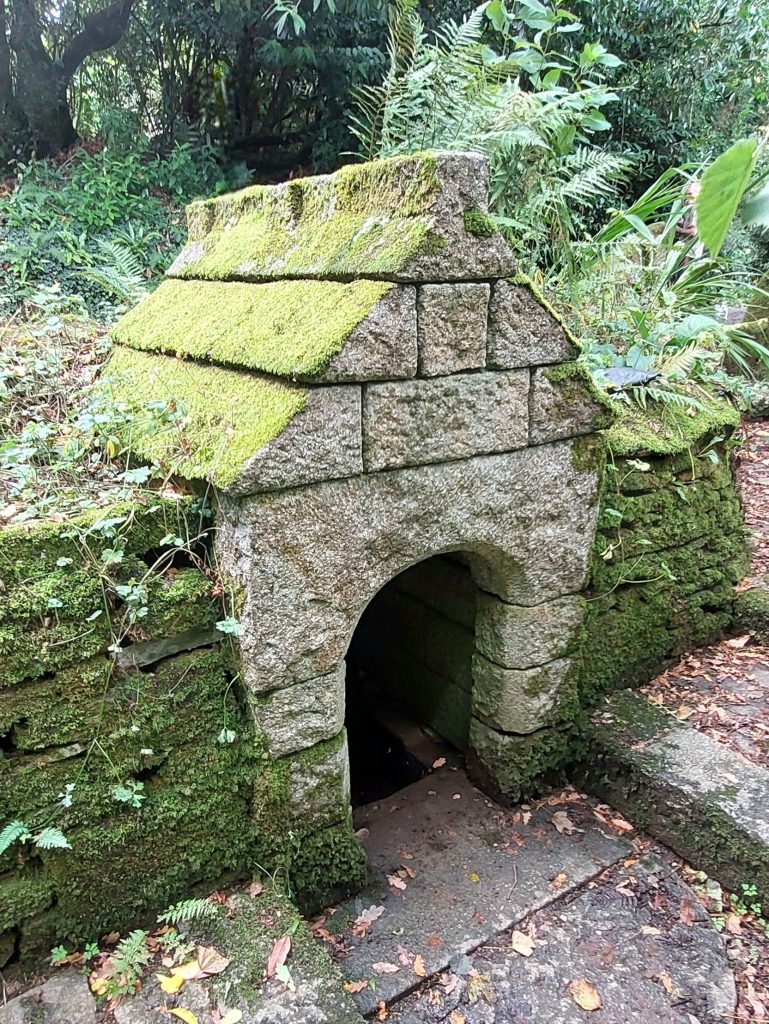
    The one that really stuck with me, though, was St Keyne’s Well. We found it at a small shaded crossroads, tucked away with its back to the road. Like nearby St Cuby’s, it was housed in a small and simple stone shelter. But sadly the spring itself had been capped or diverted, and no longer fed the old well.

    St Keyne's Holy Well, is housed in a simple granite-block shelter set into a bank. The bank walls and the roof of the well house are green and mossy, and ferns grow around it.

    Nonetheless, the place retained its magic, surrounded by descendants of the four trees – oak, elm, ash, and willow – supposedly planted by St Keyne herself many centuries ago.

    Charming as the site was, it was really the folklore that intrigued me here. The story goes that St Keyne, a Welsh princess, laid a spell on the spring – though why is unclear – such that if a husband or wife drink from the well, whoever drinks first will gain mastery in the marriage.

    As I delved deeper into the history and folklore of these Cornish wells, I found many common motifs. The saints’ stories often read as morality tales, but I couldn’t shake the feeling that these were a later Christian overlay on what were, most probably, much older sacred sites. I don’t claim to have evidence of this; rather, it was a felt sense, alongside an awareness of early Christianity’s colonising tendencies.

    That sense of ancient hallowedness is particularly strong for me at the well I now regularly visit for my drinking water, Saint Milburga’s in Shropshire.

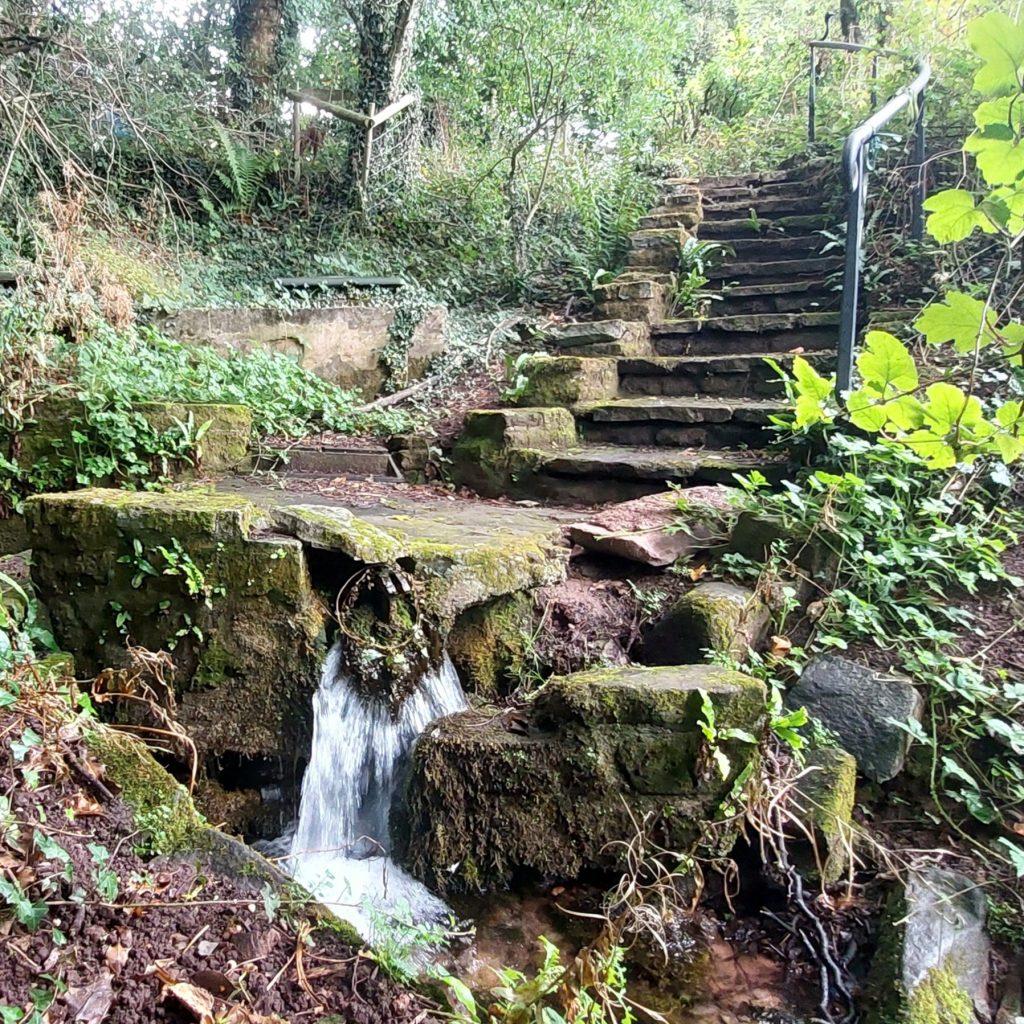
    Located at the edge of a village, a fairly modern house sits right next to the site, which feels oddly jarring. But to step through the wooden gate and follow the gently curving stone steps down towards the well itself is to leave all sense of the modern world behind.

    Ferns and wildflowers crowd the steps, green and vibrant. Native trees and shrubs, notably a Holly tree festooned with clouties, lean over the stone trough of the well. And then, emerging from a crumbling stone wall, a torrent of water spills out from a time-worn iron spout.

    The water is crisp and clear and cold. While I have no idea as to its official ‘safety’, this water seems to resonate with my body in a way which not all springs do. When I cup my hands and drink from it, I can feel its clarity seeping through my body quite literally from top to toe.

    And so this is the water with which I cook my food and quench my thirst, collected in butts every couple of weeks.

    The spring at St Milburga's Holy well. Surrounded by vegetation, stone steps curve down towards the water in the foreground
  • The Art of Car-Camping

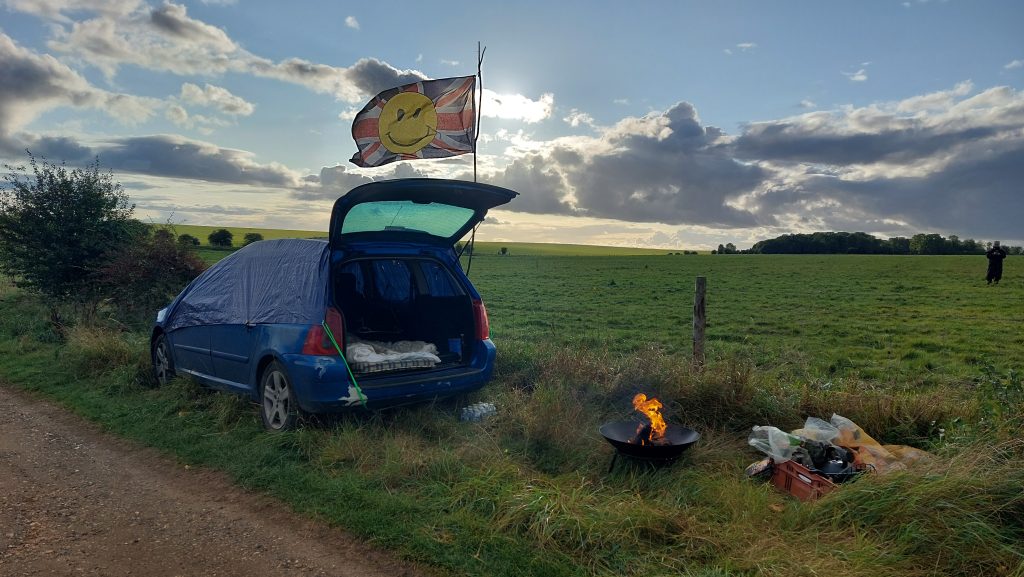
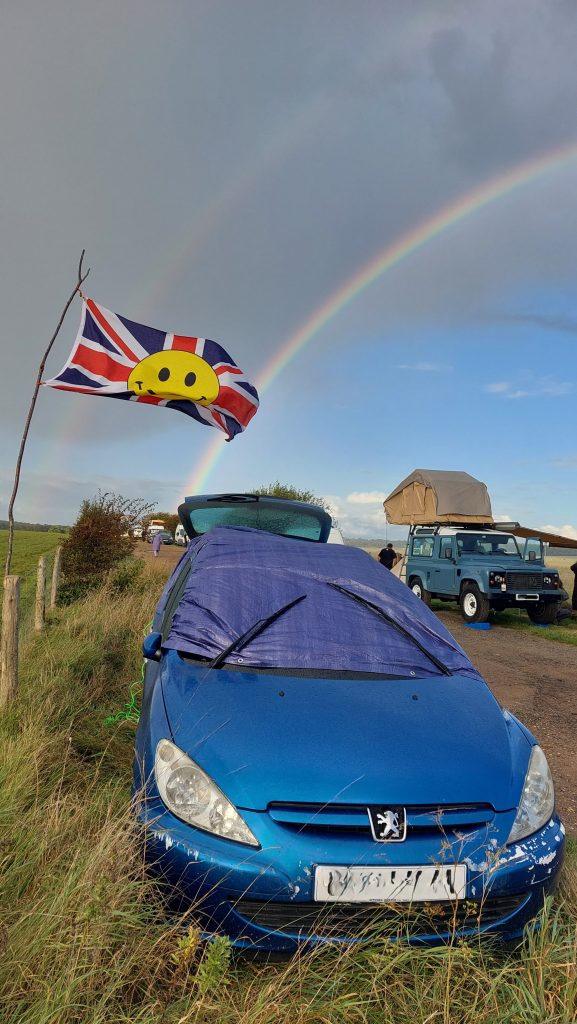
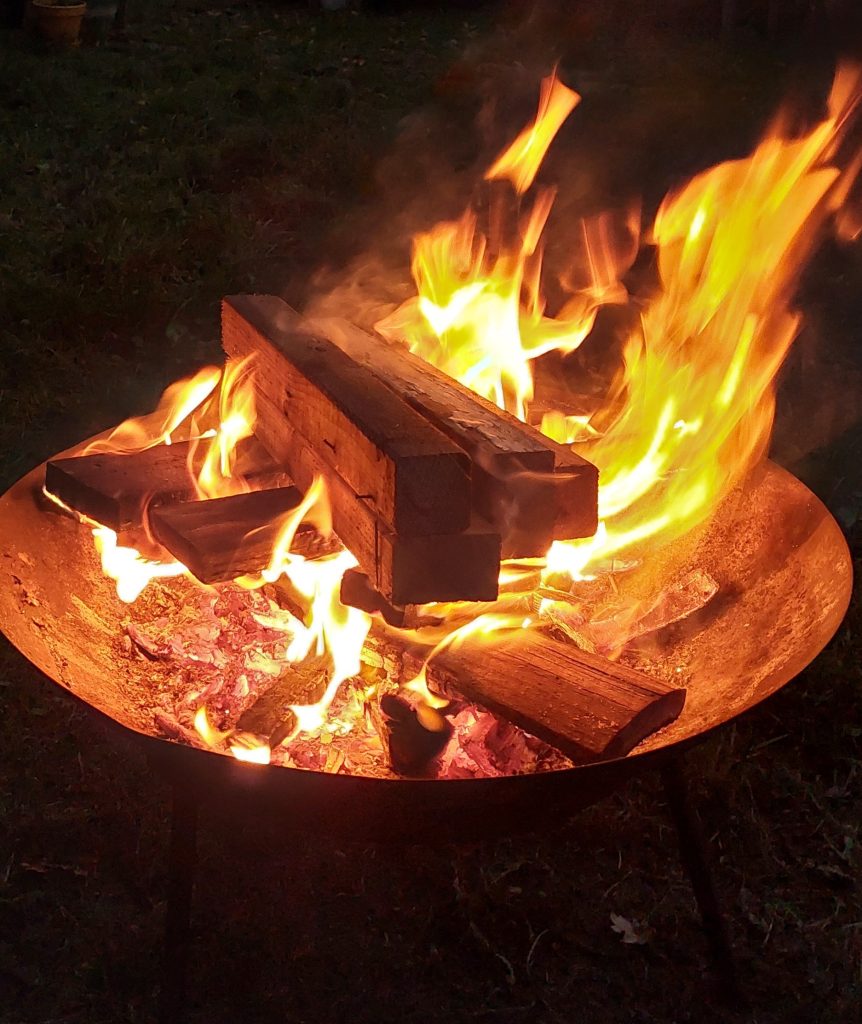
    A blue estate car, covered by a blue tarp, sits on the verge of a bridleway with the hatchback open, revealing a makeshift bed inside. The 'wally flag' (a union jack with an acid-house smiley face in the middle) flaps in the wind, while a small fire burns in a fire pit

    If I say I started car camping out of necessity, I do sort of mean that in a financial sense, but fundamentally it was for my soul. I longed to hit the road again, to sleep in the wilderness, cook on a campfire, see the stars wheeling above me, and feel the chill of dawn on my skin.

    Car camping bridged the gap between affordability and soul-hunger.

    I was fresh out of rehab when I bought a cheap old Peugeot estate off some beekeepers in the Forest of Dean. Quite frankly, I would have been happy if it had lasted me until its next MOT. In fact, it kept going for another three years.

    Primarily, I’d just wanted a car to get around in, maybe go a bit further afield. But when I discovered that the back seats of my new car were completely removable, making enough space to fully lie down, my world suddenly opened up a little wider.

    My first trip was the autumn equinox gathering at Stonehenge. With an old foam mattress from a Z-bed, a cheap fire pit, and a single-ring camping stove, I was away. Oh my God: the freedom, the fear, the feeling of coming home, and the overwhelming awkwardness of self-conscious doubt that almost immobilised me as I set about setting up.

    The blue tarp-covered car is facing the camera and other camping vehicles can be seen on the other side of the bridleway. The wally flag still flies, and a rainbow, with a feint double arc, beams across the sky

    I’d arrived on the Drove – the public bridleway that runs alongside the Stones – just as it had gotten dark. Stumbling around by lamplight, I found a space for myself amongst the other vehicles, chucked a tarp over the car for some privacy, and got a little fire going. Bliss!

    But waking to birdsong, seeing the Stones rooted in the landscape only a few hundred yards away, shrouded in early morning mist: that took my breath away.

    And as the drove slowly came to life – people emerging from vans, tents, and cars; mumbled greetings, the clatter of kettles and cups as people made their first brew – my heart swelled.

    Here was my tribe. I’d been missing them for far too long, but my cosy little car camper put me right back among them.

    After that, there was no stopping me.

    I’ve slept on cliff tops and swam in the early morning sea, stargazed on the commons enveloped by enormous skies, watched the sun go down beside rivers and streams, and watched it rise again over hills and valleys.

    I’ve always felt safer in the middle of nowhere, with no one around. I’m not going to pretend that that I don’t sometimes, in the dark of night, get a little bit spooked by strange noises or my over-active imagination. It’s not that I’m fearless, just that I cannot let fear rule.

    I read a post on social media recently by a woman who was camping alone in the remote wilderness of the Outer Hebrides. Having bedded down for the night, she was startled to hear a male voice nearby. Heart thumping, she eased open her tent to investigate and spotted a man with a large camera, trying to set up a tripod. He hadn’t even seen her tent and was out there to photograph a stunning display of the Northern Lights, which she hadn’t even been aware of.

    It reminded me of a time, many years ago, sitting around a small campfire in the woods, enjoying a pot of tea. There was a great crashing in the trees and then a man stumbled into the clearing with a shotgun. For a few incredibly long seconds, as all kinds of grisly scenarios ran through my head, we just stared at each other. And then I blurted out, “Err, would you like a cup of tea?” He hesitantly said yes, and we ended up sitting around the fire, drinking tea, and chatting for the next hour.

    I’m not saying that bad things don’t happen. I’ve spent much of my life walking the line between caution and freedom. Awareness of risk forms part of my everyday life, as it does for all women. But ultimately, freedom is too precious for me to accept a life curtailed by fear.

    I’ve learnt to trust my instincts.

    I often don’t know where I’m actually going to sleep that night when I set off on a car camping trip. There are exceptions – places that I’ve returned to – but often I just fancy exploring a particular area, or I feel the call of the sea, or of the mountains.

    On a trip to Wales last year, for example, I decided to explore a fairly remote piece of coast. By the time I arrived, it was twilight: a good time to go and park up, but not so great when you’re still looking for the right spot.

    Anxious about the fading light, I initially pulled into a big lay-by off the main road where a motorhome, already settled in for the night, offered a sense of legitimacy. I quickly vetoed that idea, though, due to the traffic noise. So I pulled up Google Maps on my phone and started looking for small turnings which led closer to the coastline. I’ve found that exploring little lanes that just peter out, or that loop away from major routes without any obvious settlements, are often the best bet. So, having identified a few candidates, I set off to seek a better spot.

    As it turned out, the first dead-end lane I tried took me to a cliff-top gravel car park with nothing around except a little chapel hunched nearby, and a holiday park on a distant hill. A few vehicles lingered – people who had come to watch the sun’s final dip into the ocean – but, parking away from these, I started setting up my sleeping space. Putting my cut-out blinds in the windows, making my bed, switching on the fairy lights. It always makes me feel a little uncomfortable, since this is the point at which it becomes obvious that I’m not just parking. My movements become stiff and awkward, and I avoid looking around, keeping my eyes focused on what I’m doing. I’ve learned to press on through this, and so far I never have been challenged.

    The car park soon emptied and the sun, having sunk below the waves, made way for an almost-full moon to gently illuminate the white-washed chapel. It was a beautiful night, with only the sound of the waves gently rolling in far below me and the cry of an occasional seagull, and I drifted into a deep sleep.

    I woke to a clear, cool morning, tinged pink by the sunrise. As I brewed my first coffee, my anxiety spiked a little as a lone car approached. The woman driver looked a bit serious and no-nonsense, and I was half expecting an ‘I’m-a-national-trust-member-you-can’t-park-here’ lecture. But her passengers (her late-teen children, as I discovered) were gazing out at me, grinning enthusiastically. They tumbled out of the car with a couple of dogs, all smiles and morning energy. After a brief chat, they invited me to join them for their early morning swim – an exhilarating start to another beautiful day.

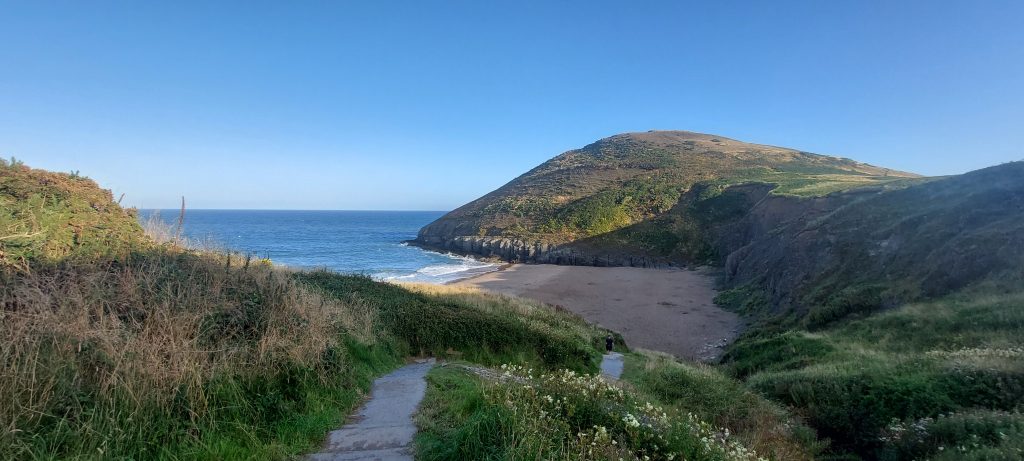
    An early morning view of a small beach nestled in the cliffs. In the forground is the path leading down to the beach.
  • Why am I here? An introduction

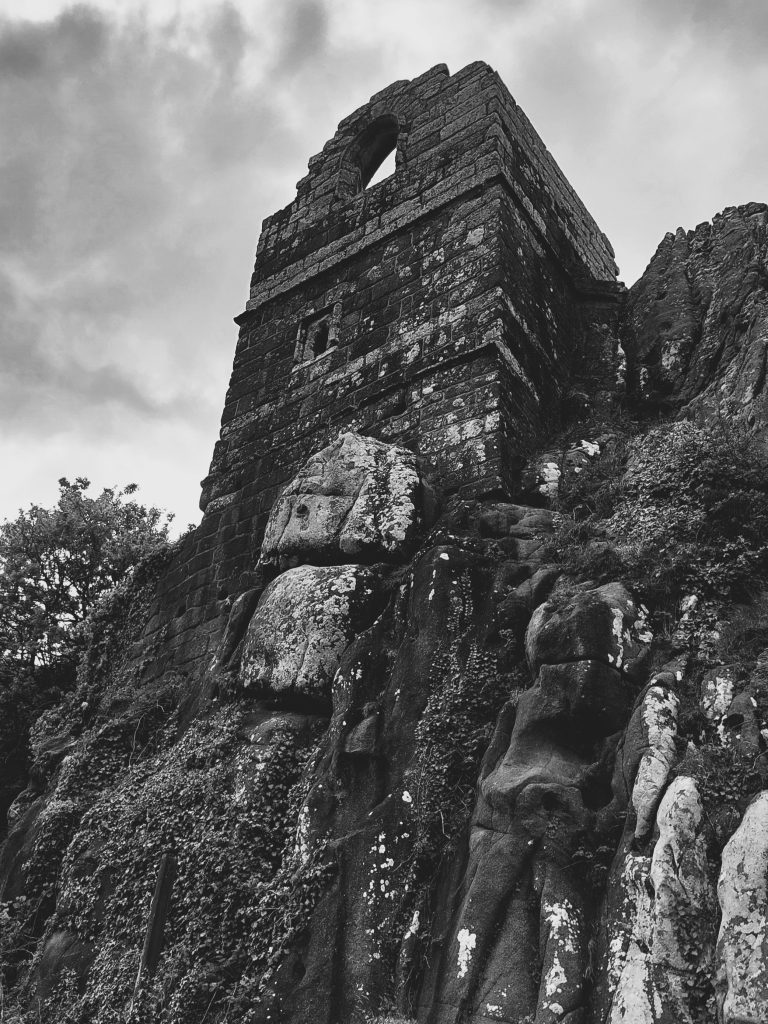
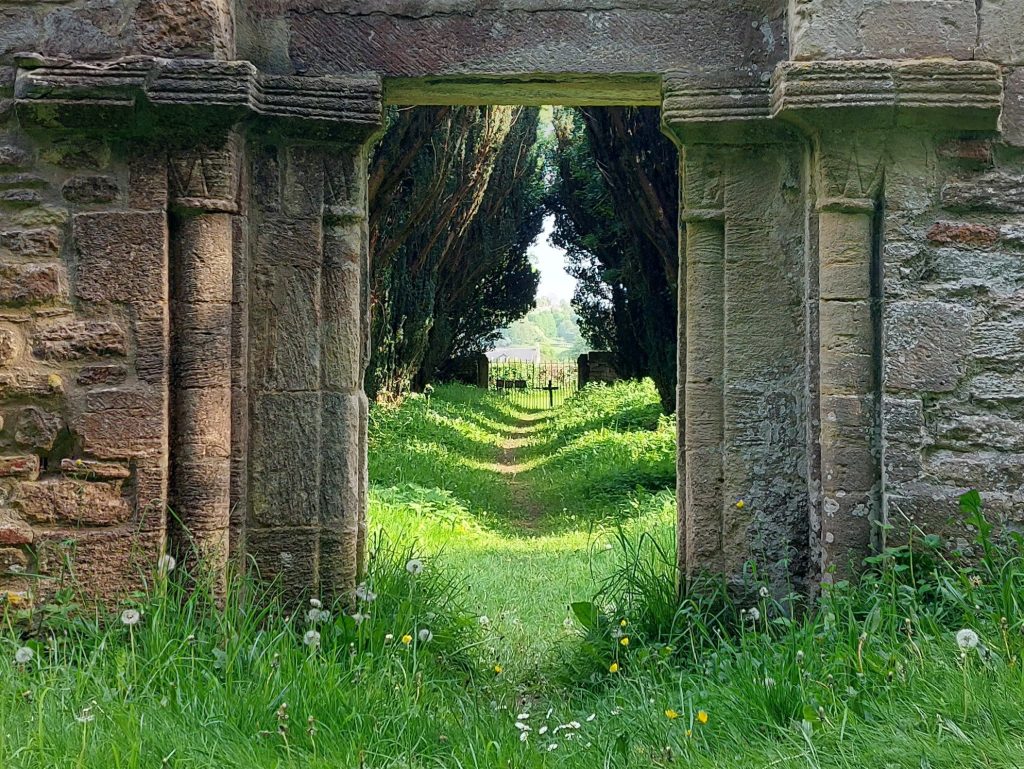
    An ancient stone doorway frames a sunlit path through an avenue of Yew trees

    “It was Aunt Lovey’s belief that all ordinary people led extraordinary lives, but just didn’t notice.”

    The quote, from a novel by Laurie Lansen, came to mind when I was recently prompted to think about my writing from a different perspective. The idea, from Simon Sinek, is to think about the ‘why’ before thinking about ‘how’ or ‘what’ I’m going to write. And the why, for me, has something to do with Aunt Lovey’s belief in finding the extraordinary where we often just see ordinary.

    Because it’s not just people’s lives that are more extraordinary than we sometimes realise: it’s the route that I always take, but never really look at; it’s my garden, or the park that I’ve walked around a thousand times, but never really seen. It’s the nearby town, or the next one over. It’s the footpath that I’ve never followed, or the road I’ve never tried. Sometimes, it’s that brown tourist-information signpost that I always ignore because, hey, I live here, I’m not a tourist.

    I love getting under the surface of things – people and places especially. Not in an intrusive way, but just by noticing, by paying attention. What sustains me are things like random chats with complete strangers, the stunning contrast of a ladybird on a dark green nettle leaf, the sudden vista of a blooming yellow rapeseed field against a clear blue sky. These are the accidental encounters that appear when I keep my eyes – and my heart – open.

    And then there’s the things that I seek out. The Levellers once sang: “I like to walk in ancient places, these are things that I can understand.”  And honestly, I can’t find a better way of putting it. I’ve been drawn for most of my adult life to stone circles, ancient forests, holy wells and springs, and even very old churches. It never ceases to amaze me how many of these special places are peppered throughout our little island, once you start looking. Sometimes they’re a little hidden away, but therein lies the adventure.

    But I also have other, more contemporary draws: the individuality of bus shelters in different areas; the experience of car camping; and the hidden city streets that you stumble upon without a map. Although I also have a great love of maps and can lose myself for hours, scouring an OS map.

    I guess I’ve always been a bit of a seeker. So where does that impulse come from? The influences are varied: my family history, literature, songs. As a very young child, I hitchhiked, in the arms of my far-from-conventional parents, all over the country. Later, when my parents had a car, we went to festivals and I remember being fascinated by the stories of the hitchhikers we picked up. And later still, I travelled the festivals with my own babe-in-arms, in our bus home.

    I devoured books: On the Road, The Grapes of Wrath, Down and Out in Paris and London, and even The Road Less Travelled. I was brought up with the music of Woody Guthrie, Bob Dylan, Leonard Cohen, and later I added to these with bands like Culture Shock, The Levellers, and The Pogues. But possibly most of all, and intertwined with all of that, was my experience of feeling like an outsider, and the incremental healing that occurred through tiny interactions with people and places.

    Belonging and connection: from a young age, these were reached for. They have become, over the years, central to who I am. And I found these through noticing, through treasuring, through engagement with places and people, both in my locale and on road trips near and far.

    The point is that I don’t have to go far at all. I mean, don’t get me wrong, I love foreign travel too. In fact, one of my favourite holidays was cycling through France on a rickety old sit-up-and-beg bike with rod brakes. It took me a long time to realise that it was simply the pace of travel, the opportunities to really notice, that made it such a memorable trip. And that pace, that level of noticing, can transform even the most mundane journey.

    My lived experience was further bolstered when I went to university, late in life. There, I read Zygmunt Bauman’s revealing juxtaposition of tourists and vagabonds, and Tim Cresswell’s politics of mobility, not to mention Judith Okely’s immersion in ‘The Traveller-Gypsies’. My world lit up because here was unexpected proof that I wasn’t alone in my world, nor my orientation to it. They helped articulate parts of my own world back to me.

    Yet somehow, I came full circle and returned to the life of an outsider, living in a truck. But I no longer feel like an outsider.

    I feel deeply rooted in the countryside around me and in the people of my community. Not just the other travellers nearby, but the people who pass randomly through my life and leave a little trace of themselves, a little bit of their story, with me.

    We are all extraordinary in our own little ways, and we live in extraordinary places. If we take the time to notice.