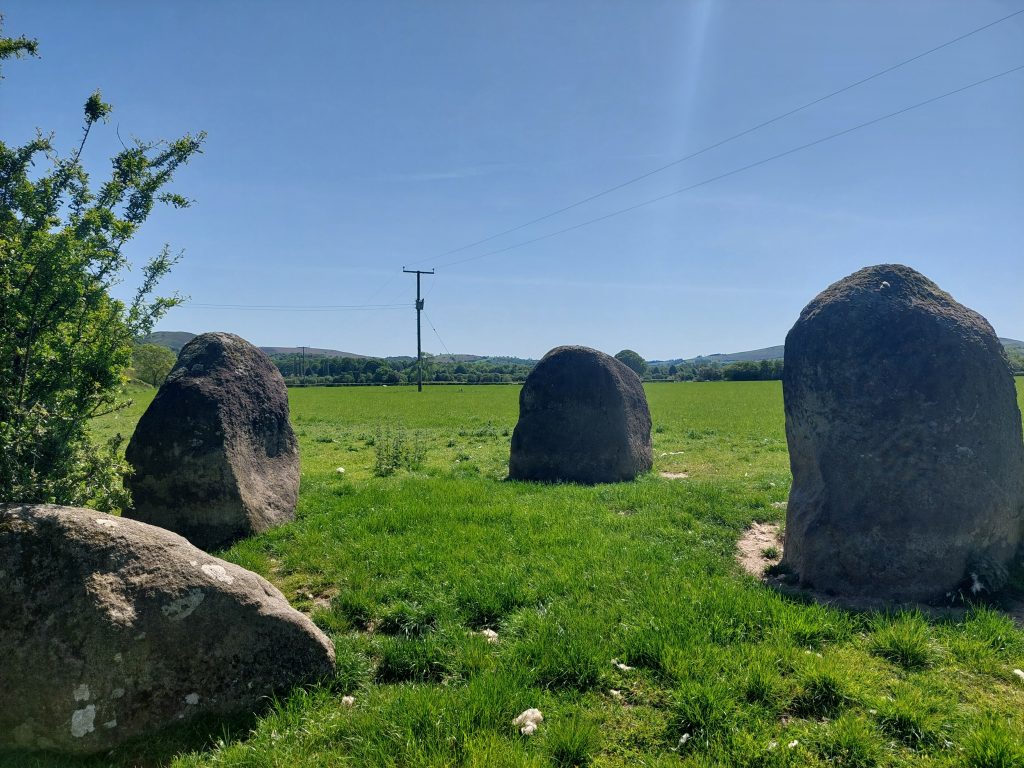
Behold, the newest member of my rocky family. Not a newborn baby, but a set of four stubby stones.
Hidden behind a hedge at the edge of a sheep field, these rocks were more ‘rectangle’ than ‘stone circle’. Found with the combined efforts of Alfred Watkins, Ordnance Survey, and online navigation, their location was distinctly unwelcoming. No public footpath, just a locked gate on a narrow country lane.
There’s something quite utilitarian about this part of the country, very different to the curated landscape of the nearby Cotswolds, welcoming hikers and tourists alike. Here, farmers plough deep furrows right to the edge of their fields, ignoring ancient rights of way.
On that basis, and with the stones beckoning to me, I climbed the gate and went to meet them.
I’m no geologist, so I couldn’t say from what rock these menhirs were cut, but I ran my hands over their gritty, quartzy surface and noticed their differing patches of warmth and coolness. I couldn’t help feeling they had been cheated, these stones, so unceremoniously tucked away.
They’re said to mark the graves of four kings who died in battle on this plain, but an older story says that a fifth stone was removed to the nearby church, smoothed and hollowed out for a font. Of course, I visited that too, but it just didn’t speak to me in the same way.
It’s an ancient kinship, this connection I feel to rocks and stones. They stand witness to repeated human passage, waypoints in the landscape, marked across millennia. I’m one of those people who returns from a walk with at least one random stone in my pocket. But especially, I can’t resist a stone circle, a craggy tor, an old stone church, or even the relatively modern follies so beloved by the Victorians.
I can think of two such follies that really drew my attention; geographically distant, yet sharing an atmosphere that could have placed them side by side.
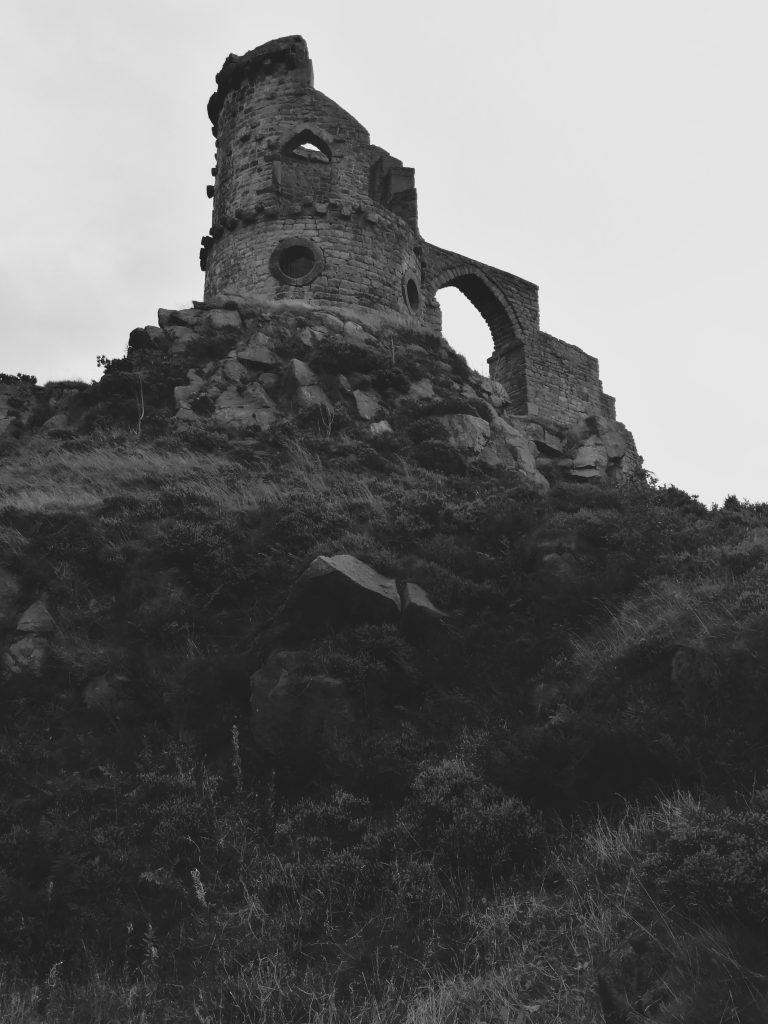
The first, Mow Cop, was met during a narrowboat journey from Manchester to Reading. It brooded on the horizon, reflecting something of the chill October day, and called for closer acquaintance.
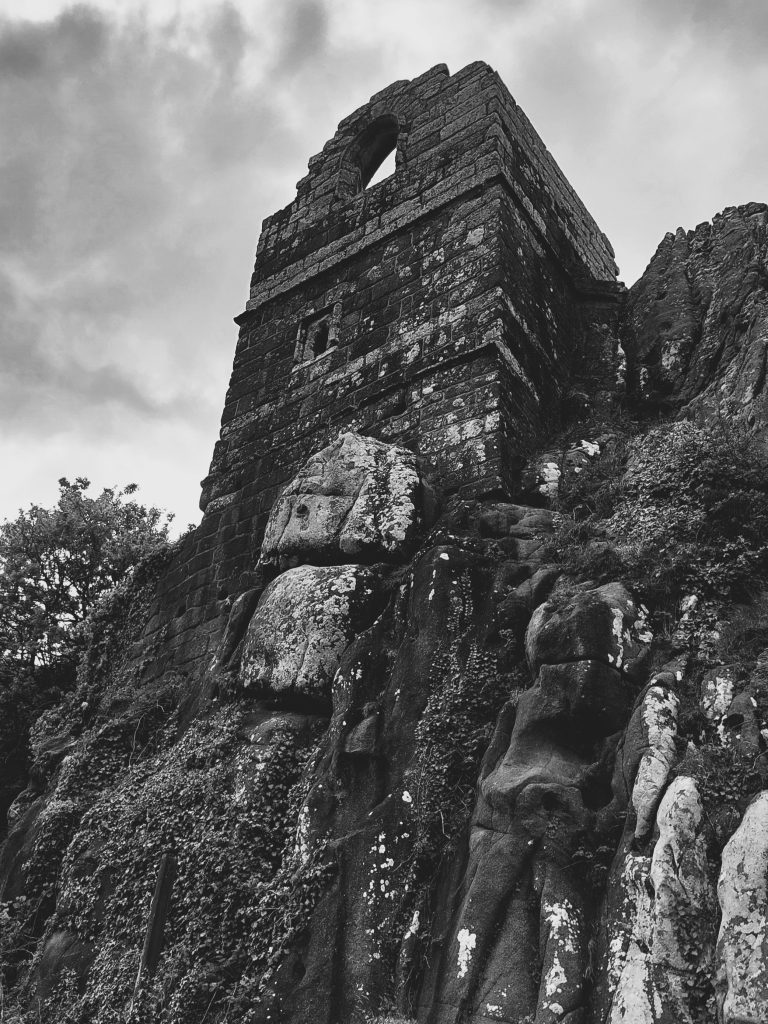
Roche Rock, also spotted mid-journey but in Cornwall, fooled me for a folly but turned out to be a medieval chapel. They could’ve been built by the same hand, despite the centuries and miles that separate them.
And then there’s Brentor. Very clearly a church, albeit somewhat unusual. It is, however, the granite outcrop it sits upon that draws me back here time and time again. I have lain on those rocks in summer’s haze and full moon’s shimmer, and never have I felt more at home.
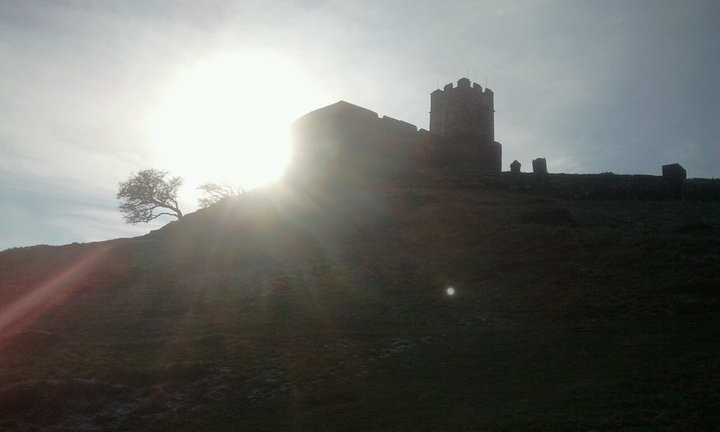
All three feel imbued with a sense of ancient history, folded into the blocky constructions of a more modern humanity. What fascinates me is the evidence of ordinary, everyday life in these ceremonial landscapes: Iron Age querns, Neolithic hearths, knapped flint, and even roasted hazelnut shells.
A hop and a skip southwest of Brentor is another favourite: Merrivale Stone Circle. I used to bring my daughter up here when she was little, to lean against the stones sharing a flask of milky tea and half a packet of biscuits. Easy to reach from the road, yet it felt like a remote wilderness and we rarely encountered another person.
We would dance in and out of the tiny circle, and process along the jagged stone row, responding to something impish and childlike about these lonely rocks. I’ve no doubt there’s a bit of mischief in Merrivale. Another time, alone, with clouds scudding across the full moon, I stumbled towards the silhouette of an outlying stone, only for it to transform into a cow and wander off.
Much as I love stone circles, Avebury leaves me cold. Instead, it’s the nearby long barrow at West Kennet that stole my heart. Limited parking, a short but sloping climb to reach it, but then: wide open landscape, huge skies overhead, and Silbury Hill squatting in the distance. I go there to sit atop the barrow and breathe.
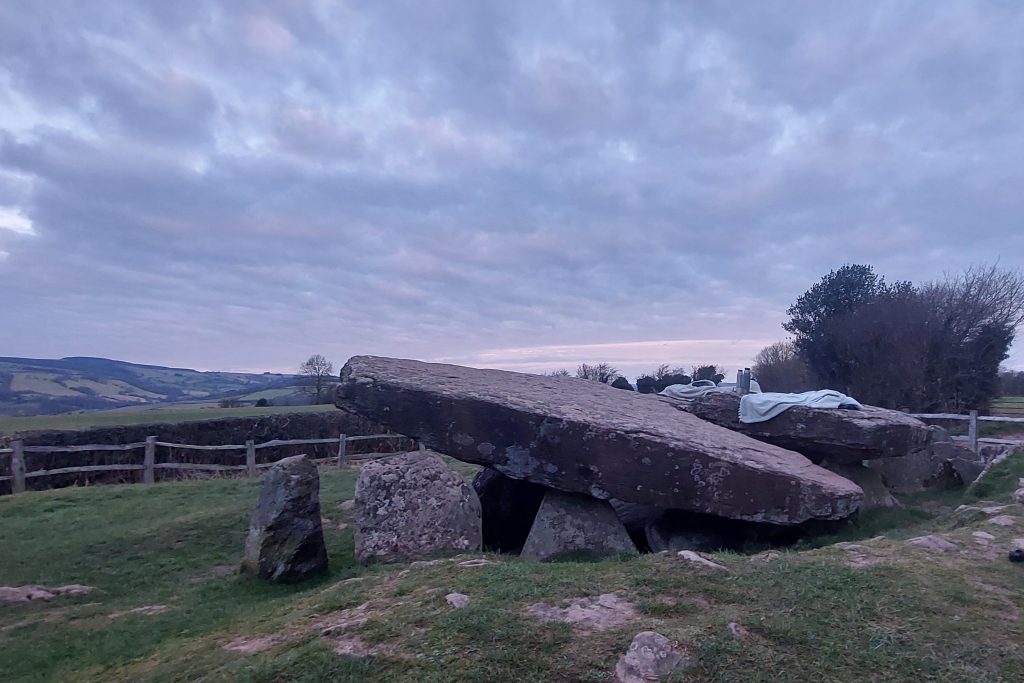
Another breathing space, closer to home: Arthur’s Stone. A large slab of rock held aloft by the stone walls of a partially collapsed chamber. There’s not much of a burial mound left on this hilltop, but the huge capstone invites the body to lie back and contemplate the sky. Like the Four Stones, it sits slightly neglected beside a country lane. But I love it all the more for its unassuming aspect.
I’ve sat here watching dawn unfold across the sky, then returned home to a warm stove and some breakfast.